Documentation Index

Fetch the complete documentation index at: https://docs.miramarket.org/llms.txt

Use this file to discover all available pages before exploring further.

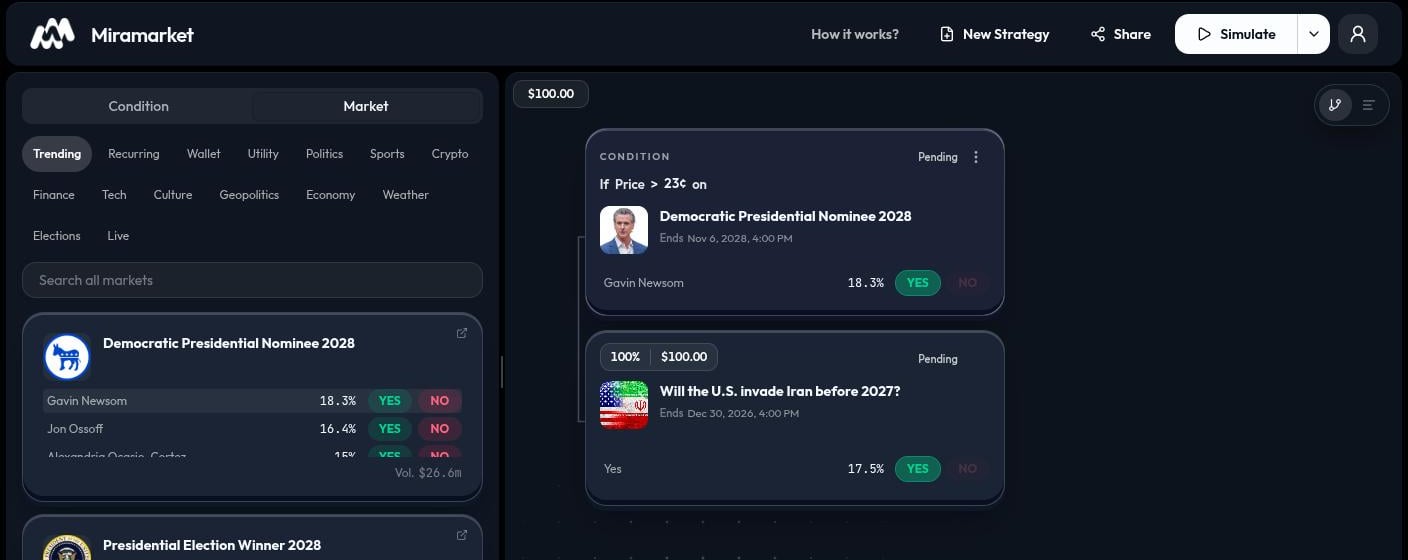
The strategy builder is a visual canvas for creating automated prediction market strategies. You arrange conditions and actions into a graph, then Miramarket converts that graph into strategy JSON.

Strategy graph

A strategy graph has two node types:
Node typePurpose
CONDITIONWatches a signal and decides which action or actions can run.
ACTIONMoves capital, places a trade, holds a position, or exits to a wallet or vault.
Conditions decide. Actions move capital.

Root node

Every strategy has exactly one root node. The root may be a condition or an action. If the root is a condition, the strategy waits for that condition and then selects actions in its decision group. If the root is an action, the strategy immediately allocates capital to that action. The action may then lead to child conditions.

Levels

Levels describe graph depth.
  • The root node is at level: 0.
  • A condition and the actions it selects stay on the same level.
  • Level only increases when an action leads to a child condition.
This keeps decision groups readable and makes the strategy JSON deterministic.

Decision groups

A decision group contains one condition and one or more actions at the same level. Use a decision group when a condition should select capital movement.
ModeMeaning
SINGLEThe condition selects one action.
SPLIT_100The condition selects multiple actions, and their allocation_pct values must sum to 100.

Canvas workflow

You typically build in this order:
  1. Add a market, wallet, vault, or hold action.
  2. Add a condition when you need decision logic.
  3. Connect the condition to one or more actions.
  4. Set allocations for split groups.
  5. Add child conditions after actions when the strategy should continue.
  6. Validate the strategy.
  7. Export strategy JSON.

Agent guidance

When generating strategy JSON, preserve these rules:
  • Use CONDITION only for decision logic.
  • Use ACTION only for capital movement or trade execution.
  • Put every condition in exactly one decision group.
  • Use edges only for action-to-condition continuation.
  • Encode condition-to-action selection through decision_groups, not edges.